Lessons I Learned While Decorating a Small Apartment & Space-Saving Secrets That Actually Made Room for Everything
Small apartments teach hard lessons. Every wrong purchase is amplified. Every design mistake is impossible to ignore.
After years of moving between cramped studios and tight one-bedrooms, the lessons accumulated. Some were expensive. Some were embarrassing. All were valuable.
The difference between a small apartment that feels cramped and one that feels cozy is not square footage. It is strategy.
This guide shares the honest lessons learned while decorating small apartments. The goal is helping others avoid the same costly, frustrating mistakes.
Why Small Apartment Decorating Is Different from Houses
Houses have extra rooms. Houses have basements, attics, and garages. Small apartments have none of these.
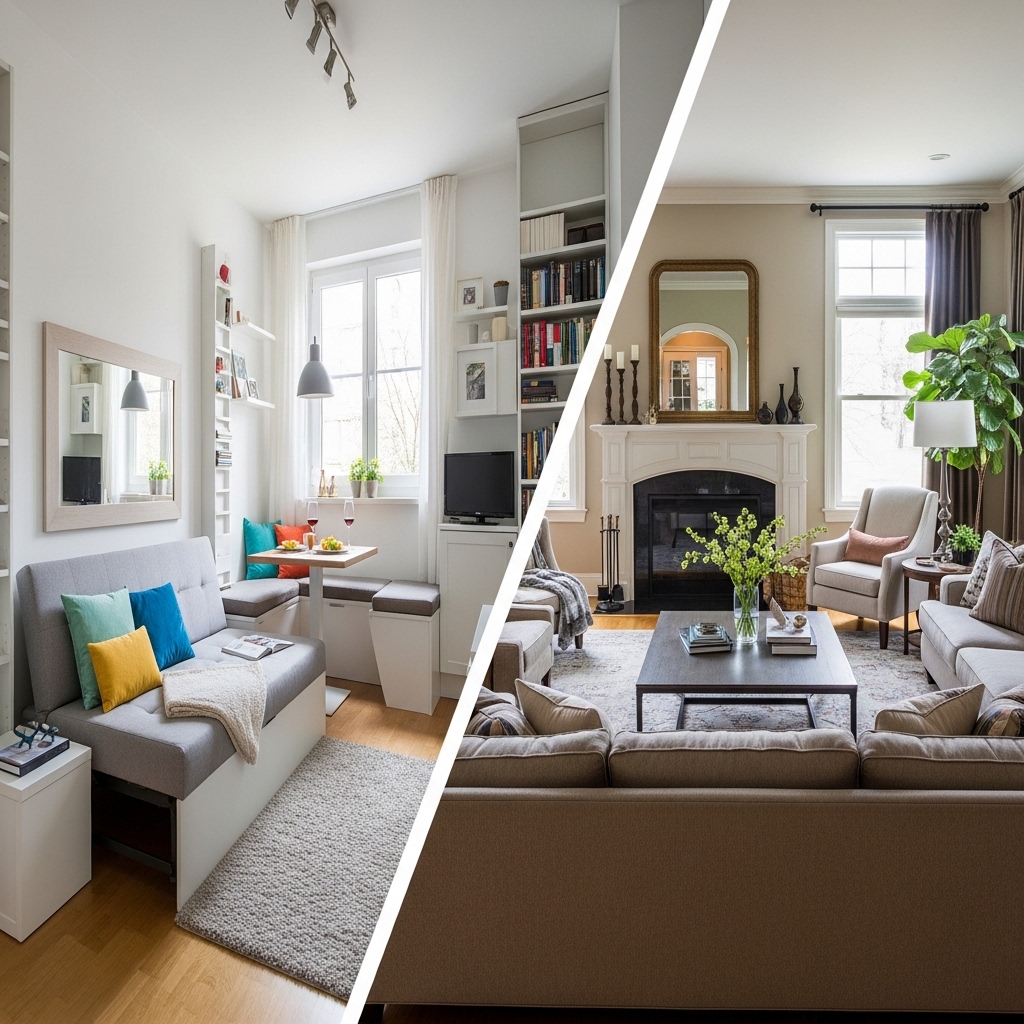
Every item in a small apartment must earn its footprint. There is no place to hide mistakes. There is no storage for things used twice per year.
The strategies that work in houses fail in small apartments. More furniture is not the answer. Better furniture is the answer.
The Mistake of Treating a Small Apartment Like a House
House decorating advice suggests layering rugs, adding multiple seating areas, and spreading decor across wide surfaces. None of this works in a 500-square-foot apartment.
The fix is accepting different rules. Less furniture. Smarter placement. Vertical thinking. Multi-purpose pieces.
Lesson 1: Measure Everything Twice Before Buying Anything
The most expensive mistake is buying furniture that does not fit. Not just through the door. Not just on the wall. Through the hallway, up the stairs, and around the corner.
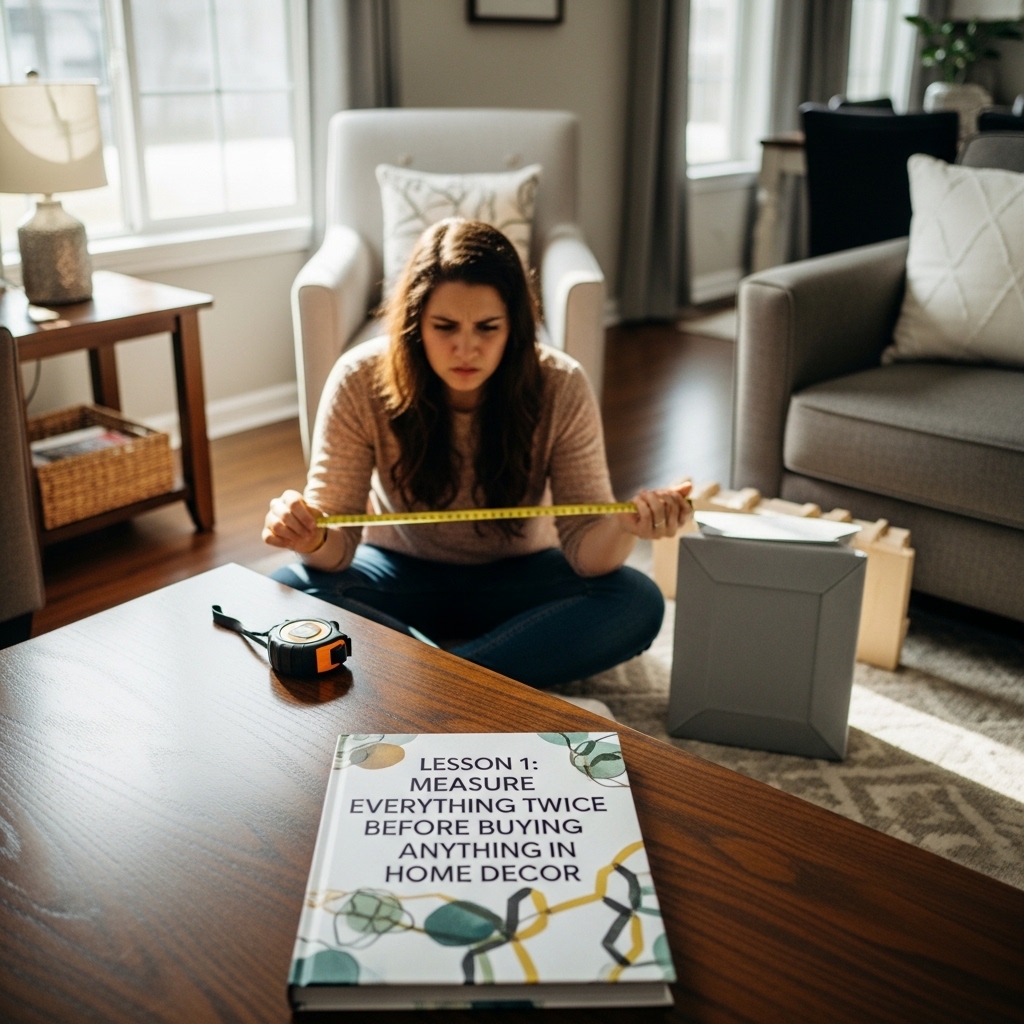
The Measuring Mistake
A beautiful sofa was purchased online. The dimensions fit the wall perfectly. The sofa arrived. The hallway was too narrow. The sofa would not turn the corner.
The sofa lived in the living room. The living room was upstairs. The sofa was downstairs in the entryway for three days while figuring out the return.
The Small Apartment Measuring Protocol
| Measurement | Where | Why |
|---|---|---|
| Wall length | Room | Furniture must fit wall |
| Room depth | Room | Walking path after furniture placed |
| Doorway width | Entry | Furniture must pass through |
| Hallway width | Hallway | Furniture must turn corners |
| Stairwell dimensions | Stairs | Furniture must go up or down |
| Elevator dimensions | Building | Furniture must fit inside |
What to Do Before Buying Anything
Measure every doorway, hallway, and stairwell the furniture will pass through. Measure the wall where the furniture will live. Measure the walking path around the furniture.
Bring a tape measure to every store. Do not trust listed dimensions without verifying.
Pro Tip: Use painter’s tape to mark furniture dimensions on the floor. Live with the tape outline for a day. See how the footprint feels before buying.
Mistake to Avoid: Do not assume standard dimensions fit standard spaces. Apartments vary. Measure your specific space.
Lesson 2: Vertical Storage Is the Only Storage That Works
Floor space is limited. Wall space is abundant. The mistake is buying low, wide furniture that consumes floor space and offers minimal storage.
The Vertical Storage Awakening
A low dresser was donated. A tall bookshelf was purchased for the same floor footprint. The storage capacity tripled.
The tall bookshelf also drew the eye upward. The ceiling felt higher. The room felt larger.
Storage Comparison: Low vs. Tall
| Furniture | Floor Space | Storage Capacity | Visual Impact |
|---|---|---|---|
| Low dresser (30″ tall) | 6 sq ft | 6 cubic ft | Grounds the room |
| Tall bookshelf (72″ tall) | 6 sq ft | 18 cubic ft | Draws eye upward |
| Wide console (36″ tall) | 8 sq ft | 8 cubic ft | Creates horizontal line |
| Wall-mounted shelves (any height) | 0 sq ft | Varies | Adds depth |
What to Look For in Vertical Storage
Choose pieces that are tall rather than wide. Look for bookshelves, armoires, and cabinets that reach toward the ceiling.
Use the top shelves for items used less frequently. Use the bottom shelves for daily items.
Pro Tip: Anchor tall furniture to the wall. Tall pieces tip over more easily than wide pieces. Wall anchors prevent accidents.
Mistake to Avoid: Do not push tall furniture against a short wall. Tall furniture needs tall walls to feel balanced.
Lesson 3: Multi-Functional Furniture Is Not Optional
Single-purpose furniture wastes space. In a small apartment, every piece must serve at least two purposes.
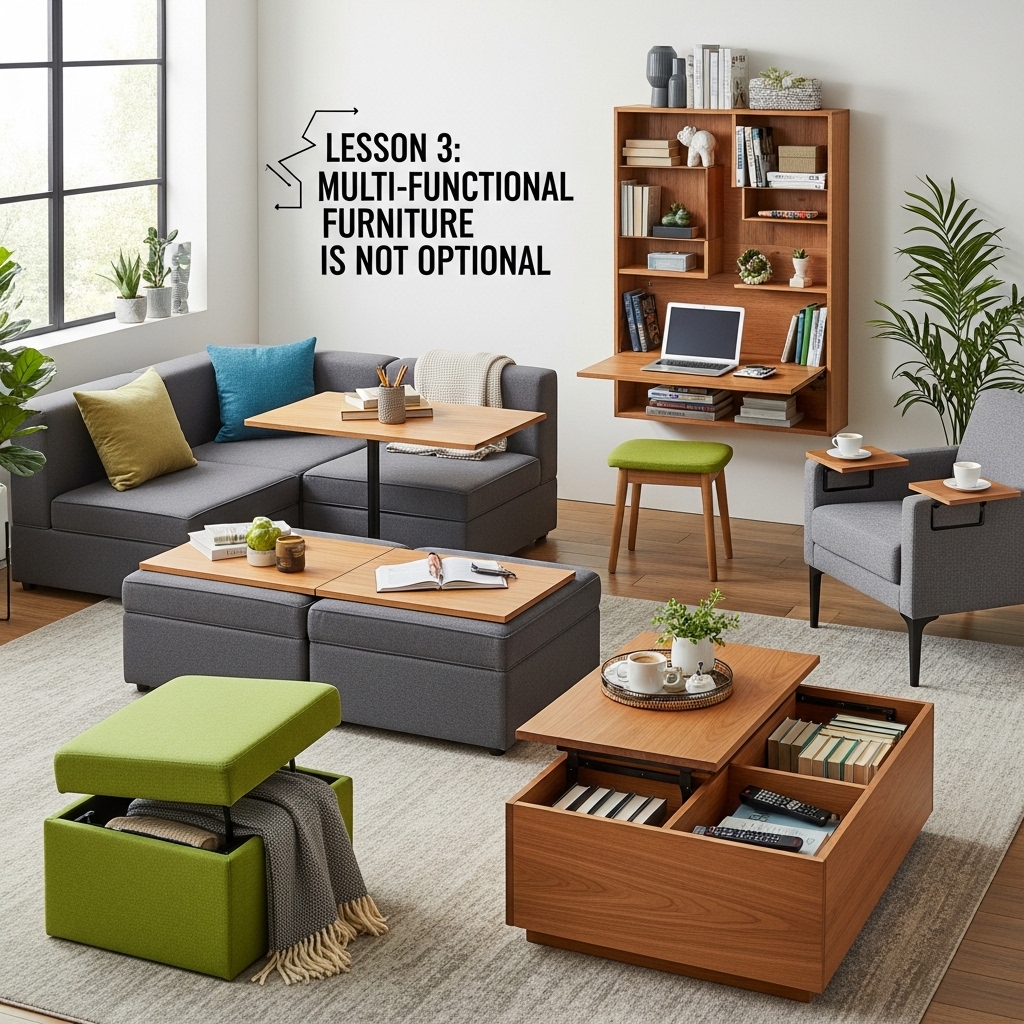
The Multi-Functional Rule
Before buying any furniture, ask: What else can this do?
| Furniture | Primary Function | Secondary Function |
|---|---|---|
| Storage ottoman | Seating | Hidden storage, footrest, table (with tray) |
| Folding wall desk | Workspace | Shelf when folded, art when closed |
| Sofa bed | Seating | Guest sleeping |
| Nesting tables | Side tables | Compact storage, extra surfaces |
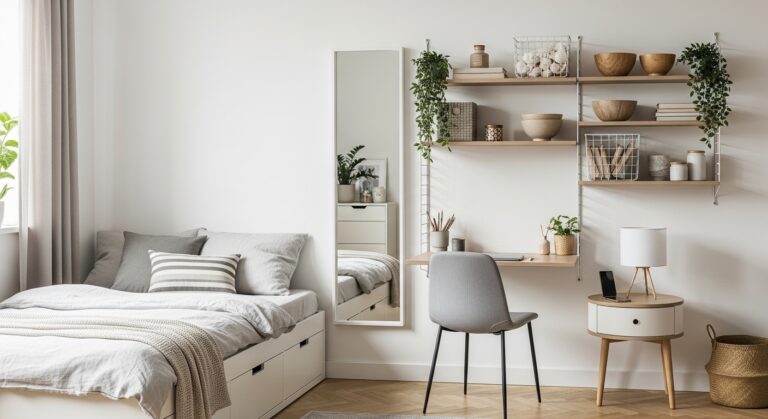
| Bed with drawers | Sleeping | Clothing storage |
The Storage Ottoman That Saved the Room
A coffee table was replaced with a large storage ottoman. The ottoman served as footrest, extra seating, coffee table (with a tray on top), and hidden storage for blankets and pillows.
One piece replaced three. The room felt larger. The functionality increased.
Pro Tip: Place a large tray on top of a storage ottoman. The tray creates a flat, stable surface for drinks and books.
Mistake to Avoid: Do not buy multi-functional furniture that is expensive and complicated. Simple pieces like storage ottomans work better and cost less.
Lesson 4: Light Colors Do Not Always Work
Conventional wisdom says light colors make small spaces feel larger. This is not always true.
The Light Color Problem
All-white walls were painted in a north-facing apartment. The room felt cold, sterile, and uninviting. The lack of natural light made the white walls look gray and sad.
When Light Colors Work vs. When They Fail
| Light Exposure | Best Paint Choice | Why |
|---|---|---|
| South-facing (warm light) | Cool whites, true grays | Balances warm light |
| North-facing (cool light) | Warm whites, creamy beiges | Adds warmth to cool light |
| East-facing (bright morning) | Most colors work | Balanced light |
| West-facing (warm afternoon) | Cool tones | Balances warm afternoon light |
| Low natural light | Warm, saturated colors | Adds perceived warmth |
What Worked Instead
A warm creamy white replaced the stark white. The room felt cozy rather than cold. The walls no longer looked gray. The space felt larger because it felt more inviting.
Pro Tip: Test paint colors on multiple walls. The same color looks different on a north wall versus a south wall. Paint large swatches and observe for several days.
Mistake to Avoid: Do not choose paint color from a tiny swatch alone. Lighting changes everything. Test on walls first.
Lesson 5: Door Space Is Free Real Estate
The backs of doors are completely empty. Most people ignore them completely. This is a mistake.
The Door Storage Awakening
Over-the-door shoe organizers, hooks, and racks turned empty door space into valuable storage.
Door Storage Options
| Product | Best For | Cost | Installation |
|---|---|---|---|
| Over-the-door shoe organizer | Shoes, accessories, cleaning supplies | $ | None |
| Adhesive hooks | Robes, bags, hats, coats | $ | None |
| Over-the-door rack | Towels, pantry items, small bins | $$ | None |
| Door-mounted mirror | Outfit checking, depth creation | $$ | Screws |
What Went on the Doors
The closet door held an over-the-door shoe organizer. Shoes were off the floor. The closet floor was clear.
The bathroom door held adhesive hooks for robes and towels. Towels no longer draped over the shower rod.
The entry door held a small mirror. Outfit checks happened before leaving, not after.
Pro Tip: Use over-the-door organizers without drilling. Most hang over the top of the door and require no tools or damage.
Mistake to Avoid: Do not overload door organizers. Too much weight can pull the door off its hinges over time.
Lesson 6: Rugs Must Be the Right Size
A small rug in a small room makes the room feel smaller. Visible floor around all four edges creates a frame that highlights the room’s limitations.
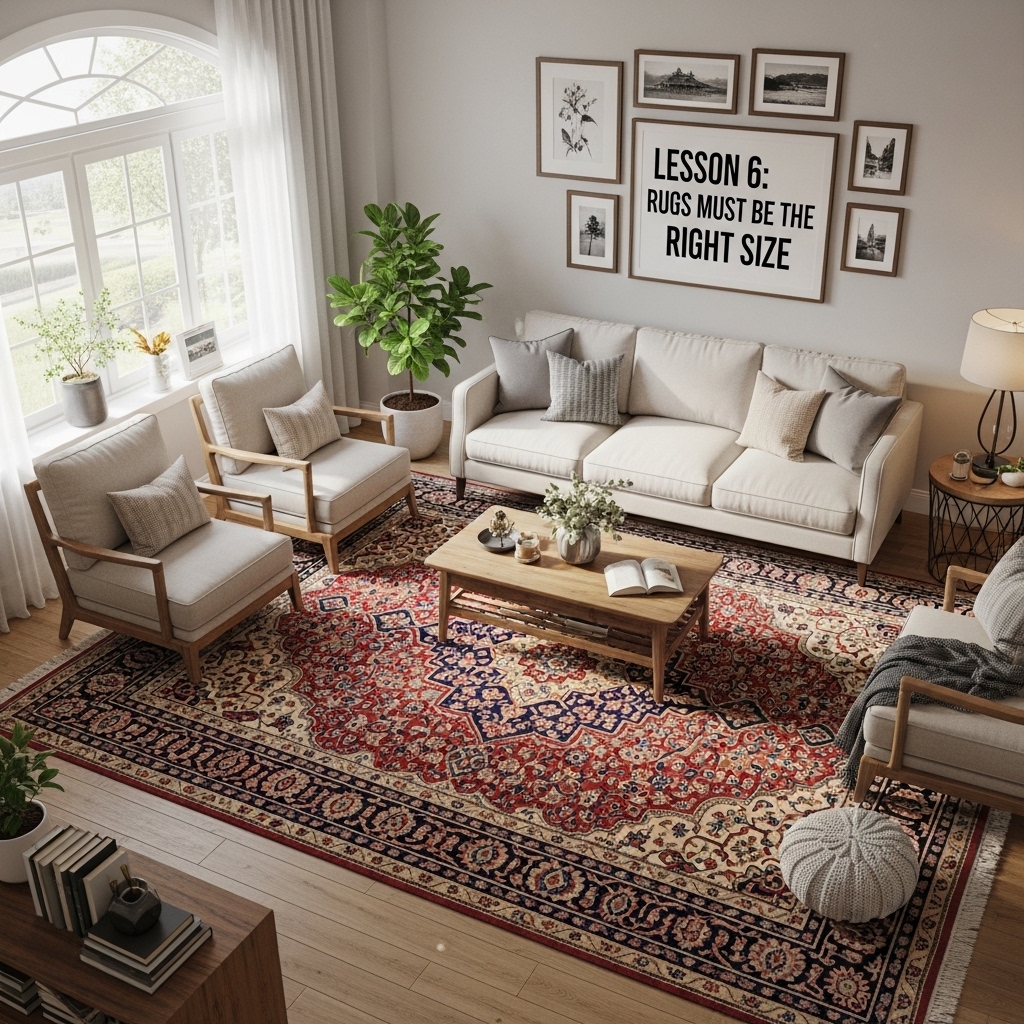
The Rug Size Mistake
A 5×7 rug was placed in a 10×10 living room. The rug floated in the middle of the floor. The room looked chopped up and smaller than its actual size.
Rug Size Rules for Small Apartments
| Room Size | Minimum Rug Size | Ideal Rug Size | Placement |
|---|---|---|---|
| Small living room (10×10) | 5×8 | 8×10 | Front legs of sofa on rug |
| Small bedroom (10×10) | 5×8 | 8×10 | Extends 18 inches beyond bed sides |
| Dining area (small) | 5×8 | 6×9 | 2 feet beyond table on all sides |
| Entryway | 2×3 | 3×5 | Centered in walking path |
The Rug Fix That Cost Nothing
The too-small rug was moved to the bedroom where it fit correctly under the bed. The living room floor was left bare. The room felt larger without the rug cutting it in half.
Pro Tip: Use rug tape to keep rugs flat. Rug tape prevents curling corners and tripping hazards.
Mistake to Avoid: Do not push a too-small rug against the wall. Floating rugs look worse than no rugs at all.
Lesson 7: Curtains Change Everything
Renters are afraid of curtains. Landlords forbid drilling. The solution is tension rods and no-drill brackets.
The Curtain Transformation
Cheap vinyl blinds were replaced with floor-length curtains on a tension rod. The room felt taller, softer, and more finished.
Curtain Rules for Small Apartments
| Rule | Why | Exception |
|---|---|---|
| Hang curtains high (near ceiling) | Makes ceiling feel taller | Very low ceilings |
| Hang curtains wide (beyond window) | Makes window feel larger | Narrow walls |
| Curtains should kiss the floor | Proportion, easy cleaning | Radiators below window |
| Use two panels per window | Fuller, more intentional | Very narrow windows |
No-Drill Curtain Solutions
- Tension rods (hold by pressure, no screws)
- Command curtain rod brackets (adhesive, removable)
- Magnetic rods (for metal doors and frames)
Pro Tip: Use blackout curtains in bedrooms. Blackout curtains improve sleep quality by blocking street lights and early morning sun.
Mistake to Avoid: Do not hang curtains that stop at the window sill. Curtains that hover above the floor make ceilings feel lower.
Lesson 8: Mirrors Are Magic
Mirrors are the cheapest way to make a small apartment feel larger. The right mirror in the right spot doubles visual space.
The Mirror Placement Rules
| Placement | Effect | Best For |
|---|---|---|
| Opposite window | Reflects outdoor light and view | Dark rooms |
| Perpendicular to window | Bounces light deeper into room | Long, narrow rooms |
| Behind lighting | Doubles light sources | Rooms with sconces or floor lamps |
| On closet door | Adds depth without wall space | Cluttered rooms |
| Gallery wall of small mirrors | Creates light reflections | Rooms with limited wall space |
The Mirror That Doubled the Room
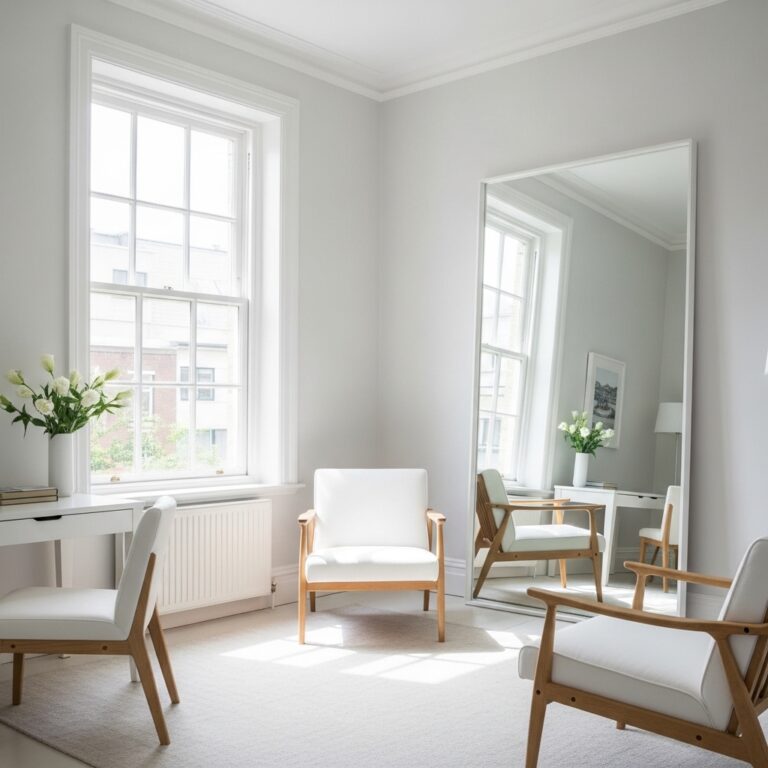
A large mirror was placed on the wall perpendicular to the window. The mirror reflected light from the window deeper into the room. The corner that was always dark became bright.
The mirror cost twelve dollars at a thrift store. The impact was worth ten times that amount.
Pro Tip: Lean a large mirror against the wall instead of hanging it. A leaning mirror feels more casual and creates a different reflection angle.
Mistake to Avoid: Do not place a mirror directly facing the bed. Seeing your own reflection while trying to sleep is unsettling.
Lesson 9: Furniture with Legs Creates Space
Furniture that sits directly on the floor looks heavy and bulky. Furniture with exposed legs creates visual space underneath.
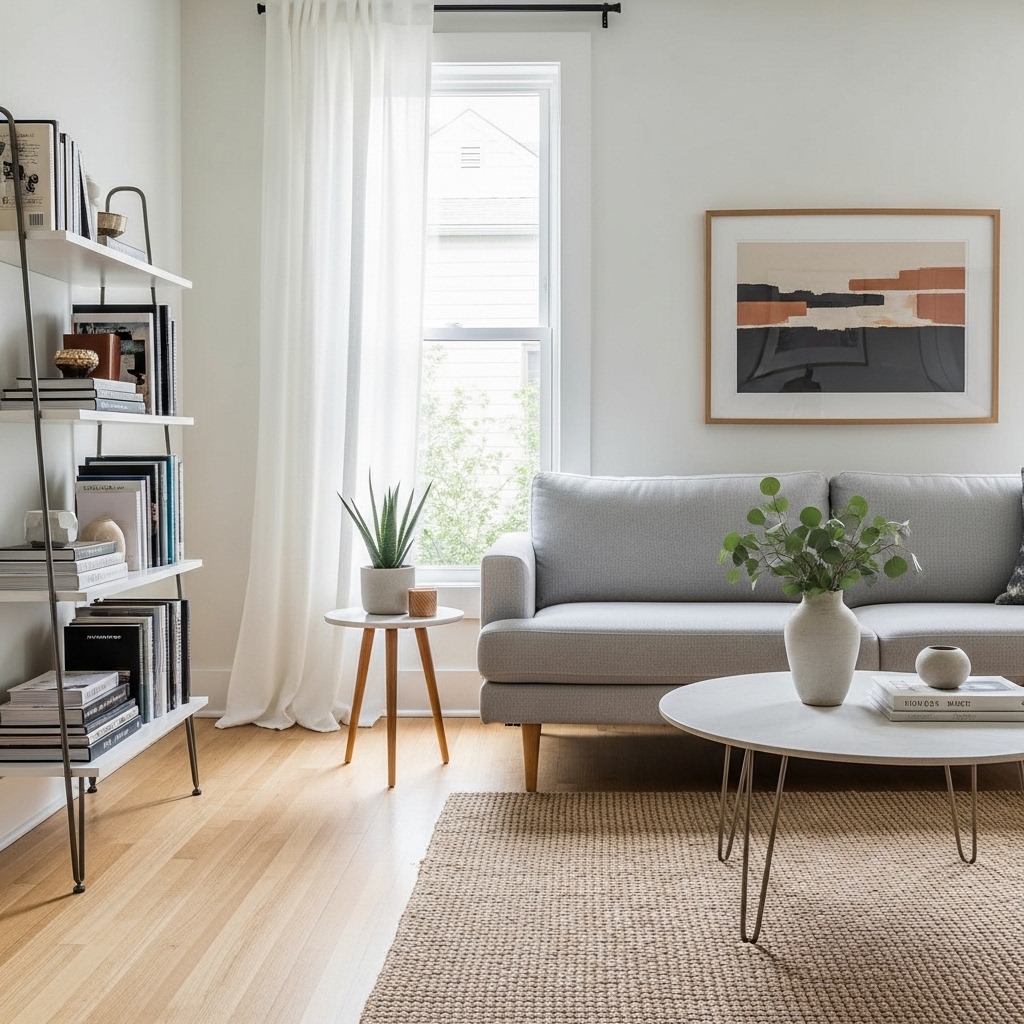
The Leg Rule
Choose sofas, chairs, beds, and tables with exposed legs whenever possible.
| Furniture | With Legs | Without Legs |
|---|---|---|
| Sofa | Looks lighter, space underneath | Looks heavy, blocks light |
| Bed | Storage underneath, air circulation | Dust trap, heavy look |
| Dresser | Easier to clean underneath | Solid block, visually heavy |
| Console | Airy, light | Chunky, dark |
The Floating Effect
Legs create a floating effect. The space underneath the furniture becomes visible. The room feels larger because more floor is visible.
Pro Tip: Use furniture with legs that are at least 4 inches tall. Taller legs create more visible floor space and allow robot vacuums to clean underneath.
Mistake to Avoid: Do not block the space under furniture with stored items. The visual space is lost when the gap is filled.
Lesson 10: The One-In, One-Out Rule
Small apartments cannot accumulate. Every new item requires removing an old item.
The Rule
For every new item brought into the apartment, one old item must leave. Donate. Sell. Trash.
How to Apply the Rule
| Category | One In | One Out |
|---|---|---|
| Clothing | New shirt | Old shirt donated |
| Books | New book | Old book donated |
| Decor | New vase | Old candle thrown away |
| Kitchen | New pan | Old scratched pan recycled |
| Furniture | New chair | Old broken chair trashed |
Why the Rule Works
Small apartments have no storage for extras. The rule prevents accumulation. The apartment stays organized without constant effort.
Pro Tip: Keep a donation box in the closet. When the box fills, take it to the donation center immediately.
Mistake to Avoid: Do not make exceptions. One exception becomes two. Two become a pile.
Lesson 11: Foldable Furniture Is Freedom
Permanent furniture locks a room into one layout. Foldable furniture allows the room to transform.
The Foldable Collection
| Furniture | Folded Size | Unfolded Function |
|---|---|---|
| Folding desk | 4 inches deep | Full workspace |
| Folding chairs | 2 inches thick | Seating for guests |
| Drop-leaf table | 12 inches wide | Dining for 4 |
| Folding screen | 6 inches deep | Room divider, privacy |
| Murphy bed | 18 inches deep | Sleeping, then wall |
The Folding Desk That Freed the Room
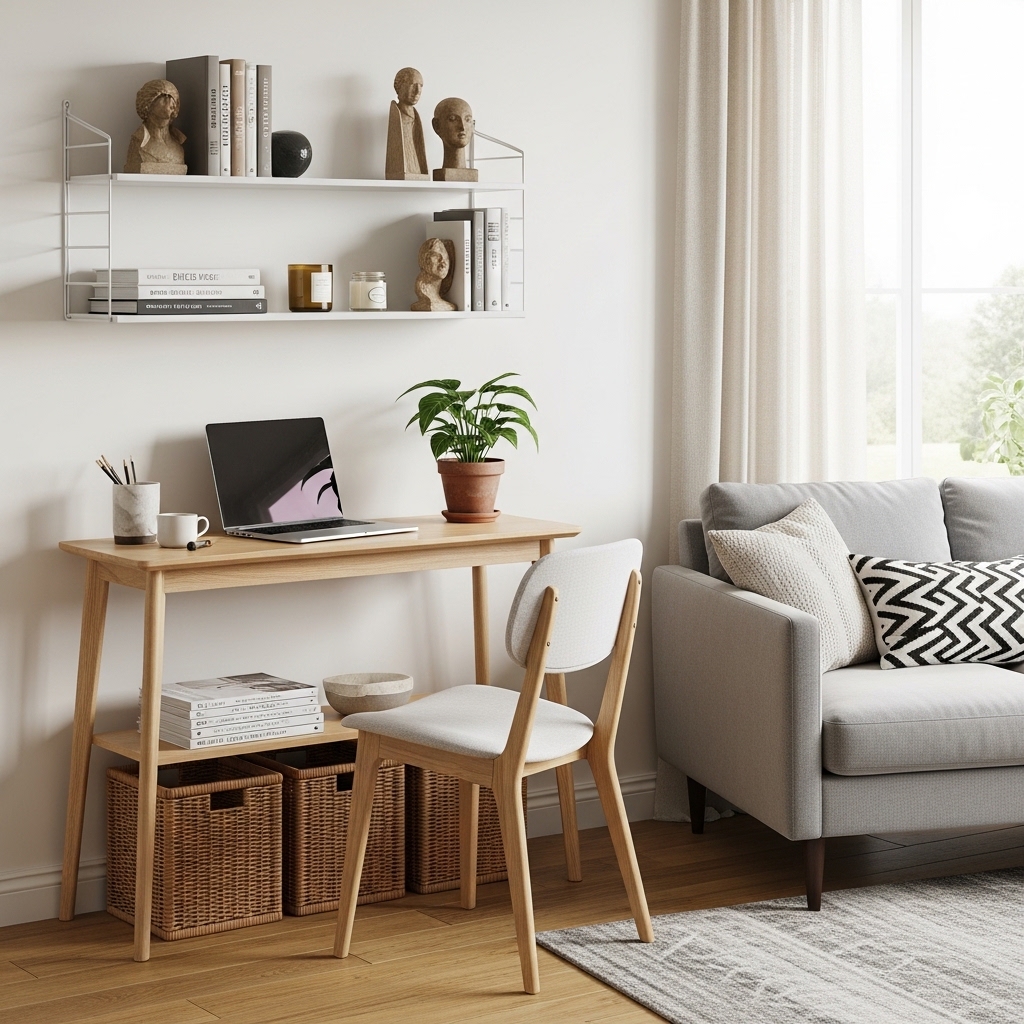
A folding desk was mounted on the living room wall. During the day, it held a laptop and notebook. At night, it folded flat against the wall. The room transformed from office to living room in thirty seconds.
Pro Tip: Mount a pegboard above a folding desk. The pegboard holds a lamp, pens, and supplies that stay when the desk folds.
Mistake to Avoid: Do not store items on a folded desk. The folded surface becomes a shelf. Items will fall.
Lesson 12: The Floor Is Not Storage
The floor is for walking. Not for storage. Not for piles. Not for boxes.
The Floor Clearing Rule
Nothing sits on the floor except furniture with legs and rugs.
| On Floor | Not on Floor |
|---|---|
| Furniture with legs | Boxes |
| Rugs | Bins |
| Plants (in pots with saucers) | Piles of clothes |
| Floor lamps | Stacks of books |
| Trash can | Exercise equipment (when not in use) |
How to Clear the Floor
Move everything off the floor. Find wall, shelf, or cabinet homes for each item. If an item cannot find a home, reconsider whether it is needed.
Pro Tip: Use under-bed storage bins for items that truly have no other home. Under-bed space is dead space. Bins make it usable.
Mistake to Avoid: Do not use the floor as temporary storage. Temporary becomes permanent within weeks.
Lesson 13: Scale Matters More Than Style
A beautiful piece in the wrong scale ruins a room. Too large dominates. Too small looks lost.
The Scale Rule
In small apartments, choose smaller-scale furniture. Lower backs. Narrower profiles. Shorter depths.
| Furniture | Wrong Scale for Small Apartment | Right Scale |
|---|---|---|
| Sofa | Oversized sectional (96″+) | Apartment sofa (72″-80″) |
| Coffee table | Large square (48″x48″) | Narrow rectangle or round (36″ diameter) |
| Dining table | 72″ long | 48″ round or 60″ long |
| Bookshelf | Wide (60″+) | Tall and narrow (30″ wide) |
| Art | Small pieces scattered | One larger piece or small gallery |
The Sofa Scale Mistake
A deep, overstuffed sofa was purchased. It was comfortable. It was also too large for the room. The sofa dominated. Walking paths were cramped.
The sofa was replaced with a smaller, shallower apartment-sized sofa. The room felt twice as large.
Pro Tip: Measure your room’s dimensions before shopping. Bring a tape measure to every store. Do not trust your eyes.
Mistake to Avoid: Do not buy furniture based on online photos alone. Scale is impossible to judge without dimensions.
Lesson 14: Hidden Storage Is Essential
Visible storage shows clutter. Hidden storage hides it.
The 70/30 Storage Rule
Seventy percent of storage should be closed (cabinets, drawers, bins with lids). Thirty percent should be open (shelves, display).
| Storage Type | Examples | Best For |
|---|---|---|
| Closed (70%) | Cabinets, drawers, bins with lids | Daily items, clutter, supplies |
| Open (30%) | Shelves, glass-front cabinets | Books, art, beautiful objects |
How to Create Hidden Storage
- Use baskets with lids on open shelves
- Choose furniture with doors and drawers
- Store items in bins, not loose on shelves
- Close cabinet doors when not in use
Pro Tip: Use matching bins on open shelves. Matching bins look intentional. Mismatched bins look chaotic.
Mistake to Avoid: Do not use clear bins on open shelves. Clear bins show the clutter inside. Use solid bins or baskets.
Lesson 15: Small Apartments Need Small Habits
Big habits do not work in small spaces. Leaving dishes in the sink. Piles of mail on the counter. Coats draped on chairs.
The Daily Reset Habit
Five minutes each evening resetting the apartment.
Bullet Point: Evening reset checklist
- Wash dishes or load dishwasher
- Wipe kitchen counters
- Put away mail and papers
- Hang coats and bags
- Fluff sofa cushions
Why Small Habits Work
A small apartment cannot absorb clutter. What looks messy in a large house looks catastrophic in a small apartment.
The five-minute reset prevents the slow slide into chaos. Morning starts with a clean, calm space.
Pro Tip: Set a recurring alarm on your phone for 9 PM. The alarm triggers the reset routine.
Mistake to Avoid: Do not skip the reset for two nights in a row. Two nights becomes a week. A week becomes chaos.
The Small Apartment Toolkit: Budget Edition
| Tool | Cost | Best For |
|---|---|---|
| Tape measure | $5 | Measuring before buying |
| Painter’s tape | $5 | Outlining furniture on floor |
| Level | $10 | Hanging art and shelves straight |
| Cordless drill | $30 (basic) | Mounting, assembling |
| Stud finder | $15 | Finding secure wall anchors |
| Command strips and hooks | $10 | No-damage hanging |
| Screwdriver set | $10 | Assembly and repairs |
The 7-Day Small Apartment Transformation Plan
Day one: Measure every room. Note doorway widths, wall lengths, and walking paths.
Day two: Clear the floor. Move everything off the floor. Find wall or shelf homes.
Day three: Assess storage. Replace low, wide pieces with tall, narrow alternatives.
Day four: Add mirrors. Place one large mirror to reflect light and create depth.
Day five: Upgrade curtains. Hang high and wide. Use no-drill solutions if renting.
Day six: Create landing zones. Key tray. Mail tray. Phone charging station.
Day seven: Establish the evening reset. Five minutes before bed. Every night.
Conclusion
Small apartments teach lessons that large houses never will. Every inch matters. Every piece must earn its place. Every habit affects the whole space.
The lessons learned were expensive. The mistakes were embarrassing. The knowledge gained is invaluable.
Measure twice. Buy tall furniture. Choose multi-purpose pieces. Use door space. Hang curtains high. Add mirrors. Clear the floor. Establish small habits.
Start with one lesson today. Measure a room. Clear the floor. Add a mirror.
Small changes compound into dramatic transformations. The small apartment can feel spacious, calm, and functional.
Take back your small space starting today. Better living is waiting in the square footage you already have.